Stop calling stops manually. Peak Transit's Automatic Voice Announcement System (AVAS) delivers ADA-compliant next-stop announcements, route information, and service alerts automatically - triggered by GPS, tied to your CAD/AVL routes, and played through the bus's existing audio system. Consistent announcements on every trip, on every vehicle, without operator workload.
Automatic Voice Announcement System for
Fixed Route Transit
Trusted by transit agencies nationwide
What is an Automatic Voice Announcement System (AVAS)?
An Automatic Voice Announcement System is the on-board technology that automatically plays next-stop announcements, route names, transfer information, and service alerts to riders on a transit vehicle - without requiring the driver to make announcements manually. Announcements are triggered by GPS as the vehicle approaches each stop, played through the vehicle's interior PA system, and synchronized with digital signs so audible and visual information match.
For fixed route transit agencies, AVAS isn't optional. The Americans with Disabilities Act (ADA) requires fixed route transit operators to announce stops at transfer points, major intersections, destination points, and intervals along the route sufficient to orient riders with visual impairments. AVAS is how agencies meet that requirement consistently - on every trip, on every vehicle, without depending on operator memory, workload, or microphone availability.
The Peak Transit difference
Peak Transit's AVAS is built specifically for fixed route operations and integrates natively with our CAD/AVL system, Mobile Data Terminals, and digital signage. The route, stop, and trigger data driving your announcements is the same data running your dispatch console - so a stop changed in one place updates everywhere.
Core Capabilities
What an automatic voice announcement system does for your agency
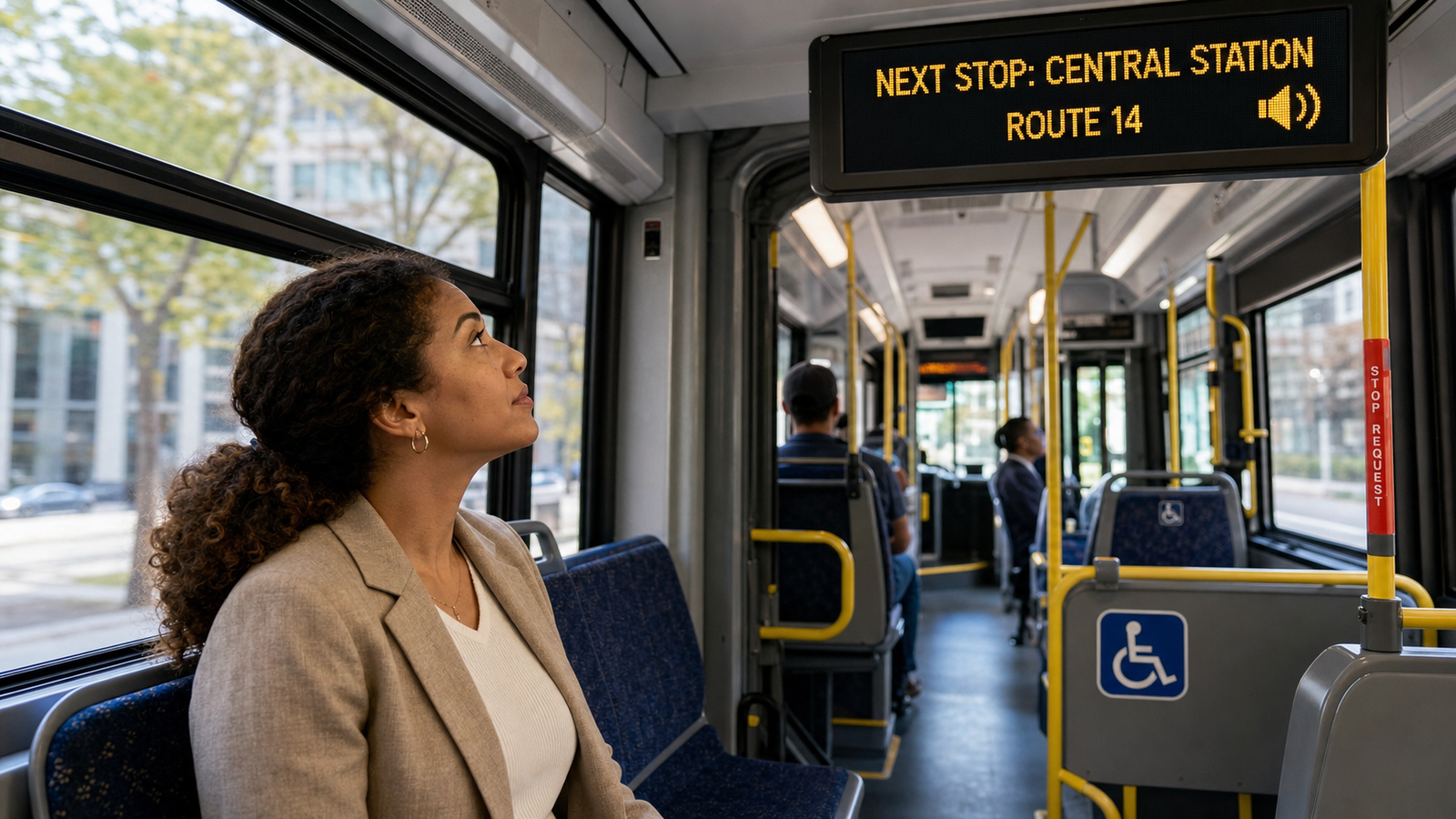
Meets ADA Section 37.167 stop announcement requirements
ADA Section 37.167(b) requires fixed route transit operators to announce stops at transfer points, major intersections, destination points, and intervals adequate to permit individuals with visual impairments or other disabilities to orient themselves. Manual driver announcements are inconsistent - drivers forget, get busy, lose voice, or skip stops. AVAS makes compliance automatic and continuous, with every announcement logged for audit.
Benefits for your agency
- Consistent compliance with ADA Section 37.167 stop announcement rules
- Eliminates operator-dependent announcement variability
- Audit log of every announcement played, by trip and stop
- Defensible record for FTA Triennial Review
- Reduces complaint and litigation risk from missed announcements
Eliminates a major source of operator workload
Calling stops on top of driving, watching traffic, managing fare collection, and handling passenger interactions is one of the most cited operator complaints. AVAS removes the announcement responsibility entirely so drivers can focus on safe operation.
Benefits for your agency
- Removes announcement workload from operators
- Operators stay focused on driving and passenger safety
- No more lost or strained voices over long shifts
- Consistent rider experience regardless of operator
- Supports operator wellness and retention

Improves rider experience and reduces missed stops
Riders who know their stop is coming are more confident, less anxious, and less likely to miss their stop. Consistent announcements reduce "did we pass it?" interactions, improve the experience for occasional riders, and make the system more accessible to people who don't ride daily.
Benefits for your agency
- Fewer missed stops and turnaround complications
- Better experience for occasional and visiting riders
- Improved accessibility for visually impaired riders
- Reduced driver/passenger interruptions during the route
- Stronger public perception of service quality
Synchronized with digital signs and the rider app
When AVAS is paired with Peak Transit digital signage, the visual next-stop display and the audible announcement are synchronized - meeting both the audible and visual stop announcement requirements of ADA Section 37.167(c) for vehicles with destination signs. Service alerts pushed to the rider app can also be announced on-board when needed.
Benefits for your agency
- Audible + visual announcements synchronized automatically
- Meets ADA audio and visual stop announcement requirements
- Service alerts can be announced on-board when appropriate
- One platform managing audio, visual, and rider-app messaging
- Eliminates mismatch between what riders hear and what they see

Replaces inconsistent driver announcements
Even with the best training, manual announcements drift. Some drivers do it perfectly, some do the bare minimum, some skip it entirely on tough days. AVAS removes that variability - every rider on every trip gets the same announcements, delivered the same way, every time.
Benefits for your agency
- 100% announcement consistency across the fleet
- Removes training overhead for announcement procedures
- Eliminates "good driver / bad driver" announcement variability
- Continuous compliance even during driver shortages and overtime
- Standardized rider experience that strengthens your brand
How it works
How automatic voice announcements work on a fixed route bus
1
GPS detects vehicle approach
The vehicle's GPS continuously tracks position against your fixed route map. As the bus approaches a stop, the system identifies which announcement should play based on the current route, trip, and direction.
2
Announcement is triggered at the configured distance
Each stop has a trigger distance - for example, "play this announcement 200 feet before arrival." Trigger distances are configurable per stop, so dense urban stops can trigger closer and rural or highway stops can trigger earlier.
3
Audio plays through the bus PA system
The announcement plays through the vehicle's existing interior audio amplifier (PA system). No separate speaker installation required on most vehicles. Volume can be configured to auto-adjust based on ambient noise or be set manually.
4
Digital signs update in sync
If the vehicle has Peak Transit digital signage, the next-stop display updates simultaneously with the announcement, satisfying both audible and visual ADA requirements.
5
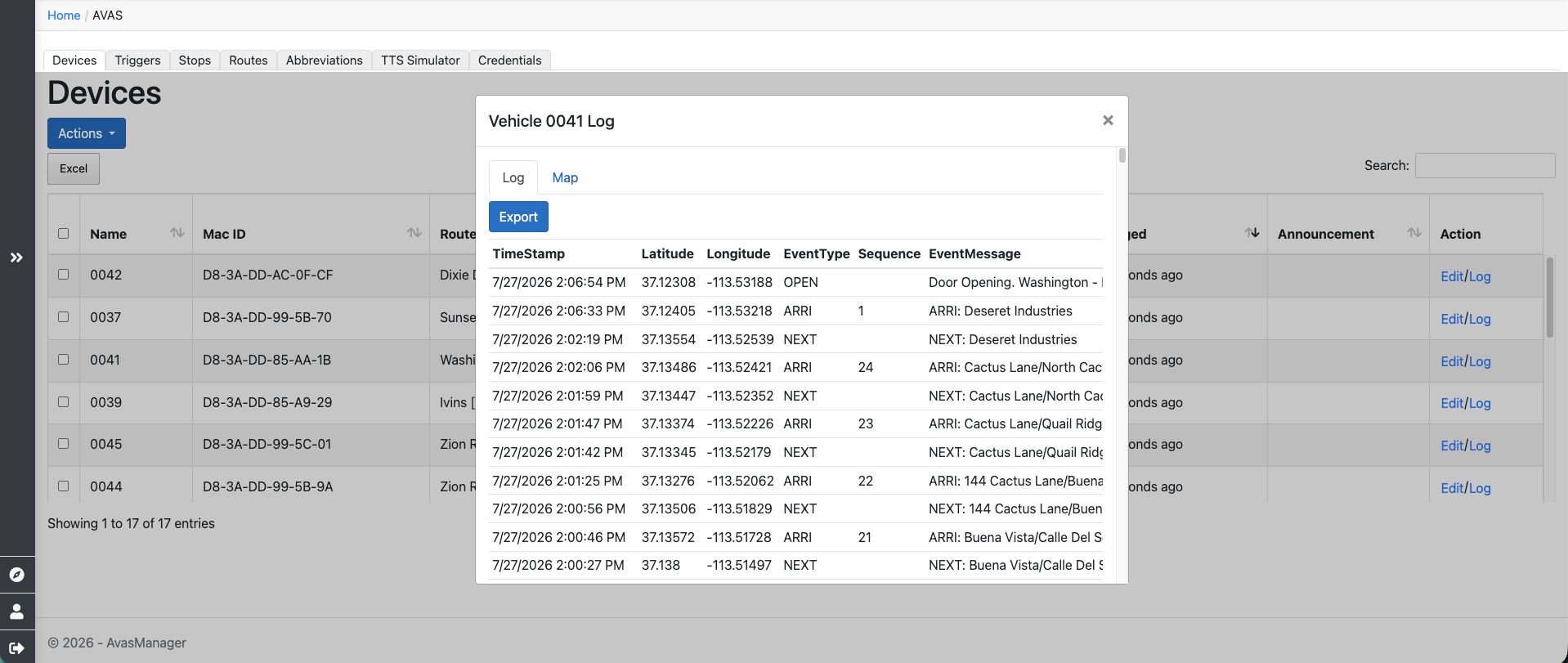
Announcement is logged for compliance
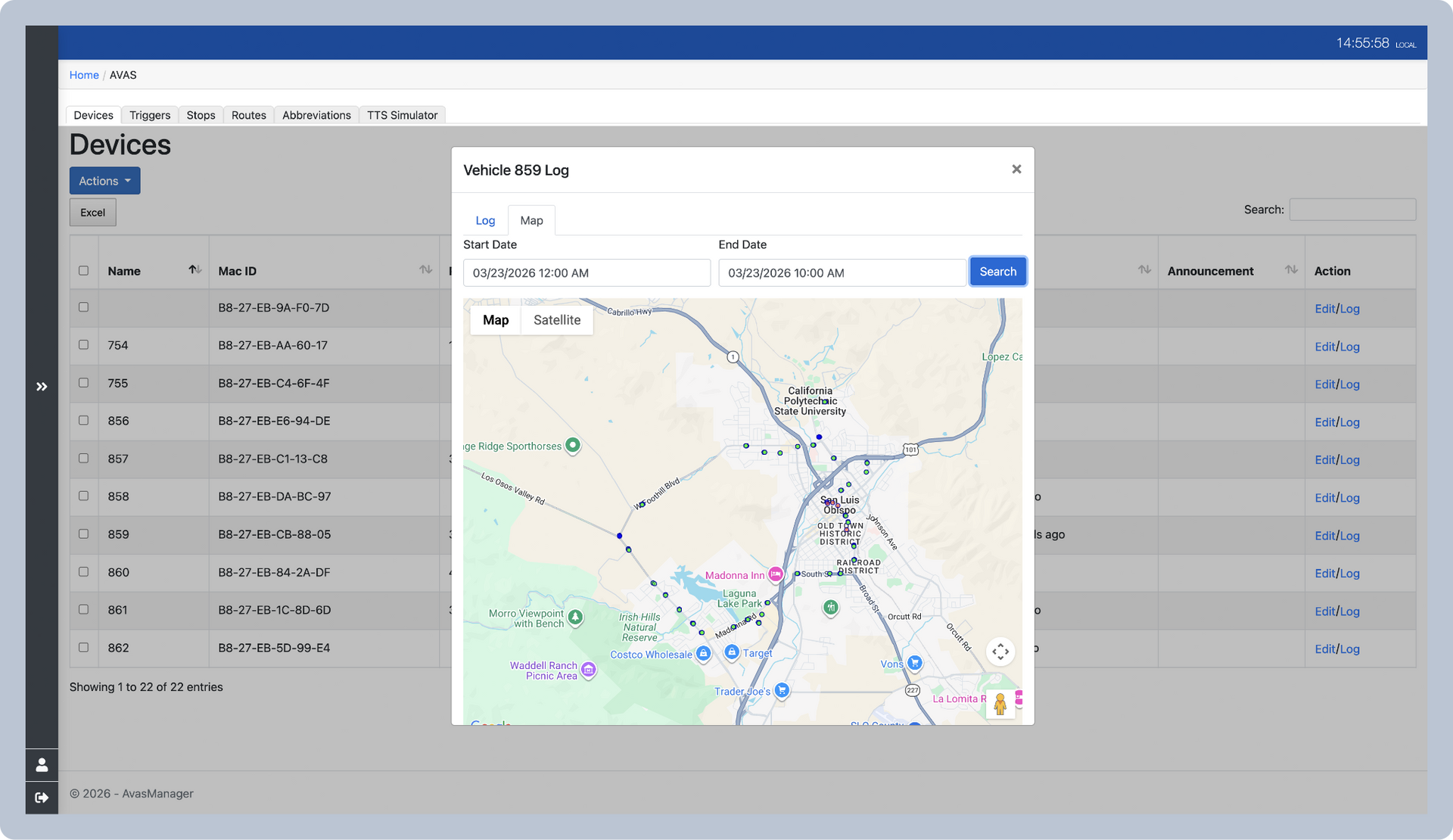
Every announcement played is logged with timestamp, GPS location, route, trip, vehicle, and operator. This audit trail supports FTA Triennial Review, ADA complaint response, and ongoing service quality monitoring.
Industries we serve
AVAS configurations tailored to your fixed route environment

City and county transit agencies deploy AVAS primarily for ADA Section 37.167 compliance and FTA Triennial Review readiness. Multi-language support reinforces Title VI obligations, and integration with CAD/AVL keeps stop announcements aligned with operational changes - detours, stop relocations, and seasonal schedules.
City buses
regional authorities
county services
Multi-jurisdictional transit

Campus transportation departments use AVAS to call building names, hall names, and academic landmarks consistently across student-operator workforces. Phonetic pronunciation control matters here - donor names, historic buildings, and language-specific campus terms need to be said correctly. AVAS removes that variability and supports accessibility services
Intercampus connectors
Parking shuttles
Campus circulators
Student housing shuttles

Airport authorities and ground transportation operators deploy AVAS for rental car center shuttles, parking lot circulators, and employee transport - environments where riders are often unfamiliar with the route, multilingual, and on tight connection timelines. Clear, consistent stop announcements reduce missed stops and confusion at the curb.
Rental car shuttles
Airport ground transport
Employee transport

Health systems use AVAS to call campus buildings, parking structures, clinical entrances, and shift-change stops clearly and consistently. Multi-language support matters in healthcare environments serving diverse patient and visitor populations, and ADA compliance is non-negotiable for any patient transportation service.
Multi-campus shuttles
Patient Transport
Shift-change Routes
Medical center parking
ADA Section 37.167 compliance
Automatic, consistent stop announcements that satisfy federal accessibility requirements - every trip, every vehicle, every time.
GPS-triggered accuracy
Announcements trigger by actual vehicle position, not driver memory. Configurable trigger distances per stop.
Multi-language support
Serve diverse rider populations with configurable announcement sequences and phonetic pronunciation control.
PA system integration
Works with the audio amplifier and PA system already installed on most fleet vehicles. No rip-and-replace.
Audio + visual sync
Paired with Peak Transit digital signage for synchronized audible and visual stop announcements.
Connected to your CAD/AVL
Routes, stops, and announcement triggers come from the same Peak Transit platform running your operation.
Technical Specifications
Enterprise-grade technology for on-board announcements
Peak Transit's AVAS meets the technical, accessibility, and procurement standards fixed route transit agencies operate under.
ADA
Accessibility compliance
- Satisfies ADA Section 37.167(b) audible stop announcements
- Satisfies ADA Section 37.167(c) visual + audible requirements with paired signage
- Configurable announcement intervals for orientation
- Audit log for FTA Triennial Review
- Supports Title VI language-access alignment
GPS
Trigger accuracy
- GPS-triggered announcements with configurable distances per stop
- Real-time route and direction awareness
- Adjusts to detours and route changes pushed from dispatch
- Manual override available to operators
Daily Sync
Connected platform
- Daily automatic sync with Peak Transit admin portal
- Native integration with Peak Transit CAD/AVL
- Synchronized with Peak Transit digital signage
- Works with existing vehicle PA and audio amplifier hardware
- Multi-language and phonetic pronunciation support
SOC2
Security & Compliance
- SOC 2 Type II certified platform
- Encrypted data transmission between vehicle and cloud
- Role-based admin access for announcement configuration
- Full audit log of every announcement played
- Regular security audits and updates
Implementation
Fast Deployment, Comprehensive Support
Most agencies have AVAS in revenue service within weeks of installation start - typically deployed alongside CAD/AVL and digital signage as part of a unified Peak Transit rollout.
Average 4 Weeks
Week 1-2: Configure & record
We import your routes, stops, and headsign data, configure trigger distances, set up your language sequences, and record (or generate) your announcement library with phonetic overrides for local pronunciation.
Week 3-4: Install & validate
Install the AVAS unit and connect to the vehicle's existing audio amplifier. Validate announcements in-vehicle, sync with digital signage, and confirm GPS trigger accuracy on every route.
Ongoing support included
Dedicated account manager, 24/7 technical support for critical issues, daily automatic updates to the announcement library, and ongoing support for route changes, new stops, and language additions at no additional cost.
Comparison
Why agencies choose Peak Transit AVAS
Fixed route agencies have three real options for on-board announcements. Here's how they compare.
Peak Transit AVAS
✓ Purpose-built for fixed route transit - routes, stops, and triggers tied to your CAD/AVL.
✓ ADA Section 37.167 compliant out of the box - audit log included.
✓ GPS-triggered automatic announcements - no driver action required.
✓ Multi-language and phonetic pronunciation - built in, configurable.
✓ Synchronized with digital signage - audible + visual ADA compliance together.
✓ Works with existing vehicle PA systems - no rip-and-replace required.
✓
Daily admin portal sync - route changes propagate automatically.
Manual Driver Announcements
✗ Operator-dependent consistency - varies by driver, fatigue, workload, and shift.
✗ Compliance gaps - missed stops, skipped intervals, voice loss over long shifts.
✗ No audit trail - can't prove ADA compliance at FTA Triennial Review.
✗ Operator workload burden - competes with driving and passenger safety.
✗
Litigation and complaint risk - when announcements are missed.
Generic Third-Party AVAS Without Integration
✗ Separate platform - announcement data lives apart from your CAD/AVL.
✗ Manual route updates - stop changes require updates in multiple systems.
✗ No sign synchronization - without integration to your digital signage vendor.
✗ Limited support model - multiple vendors for a single connected workflow.
✗
Procurement complexity - separate contracts, separate support tickets.
FAQ
Common questions about automatic voice announcements for fixed route transit
What is an Automatic Voice Announcement System (AVAS) on a bus?
An Automatic Voice Announcement System is the on-board technology that automatically plays next-stop announcements, route information, and service alerts to riders on a transit vehicle. Announcements are triggered by GPS as the vehicle approaches each stop and played through the vehicle's interior PA system. AVAS replaces manual driver announcements with consistent, automated audio delivered the same way on every trip.
Is automatic voice announcement required on fixed route buses?
Yes, in effect. The Americans with Disabilities Act (ADA), specifically Section 37.167(b), requires fixed route transit operators to announce stops at transfer points, major intersections, destination points, and intervals along the route sufficient to orient riders with visual impairments and other disabilities. AVAS is the practical way agencies meet that requirement consistently - manual driver announcements are typically not consistent enough to satisfy the rule across a fleet.
How does an AVAS know when to play the announcement?
The system uses GPS to track the vehicle's position against the fixed route. Each stop has a configured trigger distance - for example, 200 feet before the stop - and the announcement plays automatically when the vehicle reaches that point. Trigger distances are configurable per stop, so urban, suburban, and rural stops can each be tuned appropriately.
Does the AVAS work with the audio system already on our buses?
Yes. Peak Transit's AVAS is designed to integrate with the audio amplifier and PA system already installed on most transit vehicles. There's no need to replace the existing audio infrastructure on the bus. We connect the AVAS unit to the existing amplifier and the announcements play through the speakers riders already hear from.
How do you handle hard-to-pronounce stop names and street names?
AVAS supports phonetic pronunciation overrides for any stop name, route name, or street name. Local place names, donor-named buildings, historic landmarks, and language-specific names can be configured to play the way your community actually says them. This matters more than agencies often realize - generic text-to-speech engines mispronounce local names constantly.
Does AVAS integrate with digital signs on the bus?
Yes. When paired with Peak Transit digital signage, audible announcements and the visual next-stop display are synchronized automatically. This satisfies both the audible and visual stop announcement requirements of ADA Section 37.167(c), and eliminates the mismatch riders sometimes experience between what they hear and what they see.
How does AVAS support FTA Triennial Review and ADA audits?
Every announcement played is logged with timestamp, GPS location, route, trip, vehicle, and operator. That audit trail provides defensible evidence of ADA Section 37.167 compliance during FTA Triennial Review, ADA complaint investigations, and internal compliance audits.
Can drivers still make manual announcements when needed?
Yes. Operators retain manual override and silence capability. The system handles routine stop announcements automatically, but drivers can still use the PA system for emergencies, incidents, special situations, or any context where automatic announcements should pause.
How does AVAS connect to our CAD/AVL system?
Peak Transit AVAS is part of the same Peak Transit platform that powers our CAD/AVL, Mobile Data Terminals, branded rider app, and digital signage. Route changes, stop relocations, detours, and service alerts entered in your CAD/AVL automatically propagate to the AVAS - no double entry. If your agency uses a different CAD/AVL system, talk to us about integration options.
How are route and stop changes pushed to the AVAS?
Each AVAS unit syncs daily with the Peak Transit admin portal, pulling down the latest route data, stop changes, service alerts, and announcement library updates. Most agencies update once in the admin portal and the changes propagate to the entire fleet overnight.
Can AVAS announce service alerts and detours?
Yes. Agencies can configure custom service announcements - detour notices, schedule changes, special event service, holiday hours - that play at configured intervals between stop announcements. Service alerts can be pushed system-wide or to specific routes.
What's the difference between AVAS and just using a recorded loop?
A recorded loop plays the same audio on a timer regardless of where the bus is. AVAS plays the right announcement at the right time based on actual vehicle position. Loop-based announcements don't satisfy ADA Section 37.167 because they don't announce specific stops as they're approached - AVAS does.
Will AVAS work on every type of bus and shuttle?
AVAS is designed for fixed route transit vehicles - city buses, university shuttles, airport circulators, hospital shuttles, and similar service. As long as the vehicle has a PA system and 12V/24V power available for the unit, AVAS can typically be installed. Peak Transit will validate fit during procurement.
How long does it take to install and configure AVAS?
Most agencies have AVAS in revenue service within 4 weeks. This includes route and announcement library setup, language configuration, phonetic pronunciation overrides, in-vehicle installation, and validation across the route network. Phased deployment by garage or vehicle group is also available.
Is AVAS data secure?
Yes. Peak Transit operates on a SOC 2 Type II certified platform with encrypted data transmission, role-based admin access, full audit logs, and regular security reviews. AVAS captures announcement playback events only - no personally identifiable rider information.
Get Started
Ready to make stop announcements automatic, consistent, and ADA-compliant?
See how Peak Transit's Automatic Voice Announcement System eliminates operator announcement workload, meets ADA Section 37.167 requirements with an audit trail, and connects directly to the CAD/AVL platform already running your fixed route operations.