Purpose-built CAD/AVL, MDTs, rider apps, APC, AVAS, and digital signage for hospital and healthcare campus shuttles - every route, every campus, one platform built for patients, visitors, and staff.
Fixed Route Transit Software for
Hospital Shuttle Operations

Trusted by transit agencies nationwide
The Peak Transit Difference
Purpose-Built for Every Hospital Shuttle Route, From Campus Loops to Multi-Site Connectors
Hospital shuttle service carries a different kind of weight than most fixed route transit. Riders include patients managing mobility limitations, visitors navigating an unfamiliar campus under stress, and staff moving between buildings on tight shift schedules. Peak Transit is built around how healthcare shuttle service actually needs to run: defined routes, dependable timing, accessible vehicles, and clear, real-time information for everyone who depends on it.
Every feature, from the dispatch console to the rider app to the digital signs in your main lobby, is designed around the realities of healthcare campus transportation: parking-to-entrance shuttles, satellite clinic connections, employee park-and-ride routes, and a rider population that includes people for whom a late or confusing shuttle is more than an inconvenience.
One integrated platform replaces the patchwork of disconnected vendor systems many health systems accumulate across campuses and facilities, giving transportation directors a single source of truth for fleet visibility, performance data, and rider communication.
Core Capabilities
Complete Transit Tools for Every Hospital Shuttle Route
All six capabilities are purpose-built for fixed route service and fully integrated - data flows seamlessly between dispatch, vehicles, and rider touchpoints.

CAD/AVL - Real-Time Fleet Tracking & Dispatch
Give your transportation office complete live visibility into every shuttle across every campus and route. Track vehicle positions by GPS, monitor schedule adherence on parking shuttles and inter-campus connectors, and coordinate dispatchers and operators from a unified console.
What your dispatchers can do
- Monitor schedule adherence across all campus and inter-facility routes simultaneously
- Send two-way messages to operators without radio clutter
- Deploy service adjustments during shift-change surges or weather-related delays
- Receive automatic alerts for route deviations or missed stops
- Pull NTD-compliant service reports for FTA-funded operations
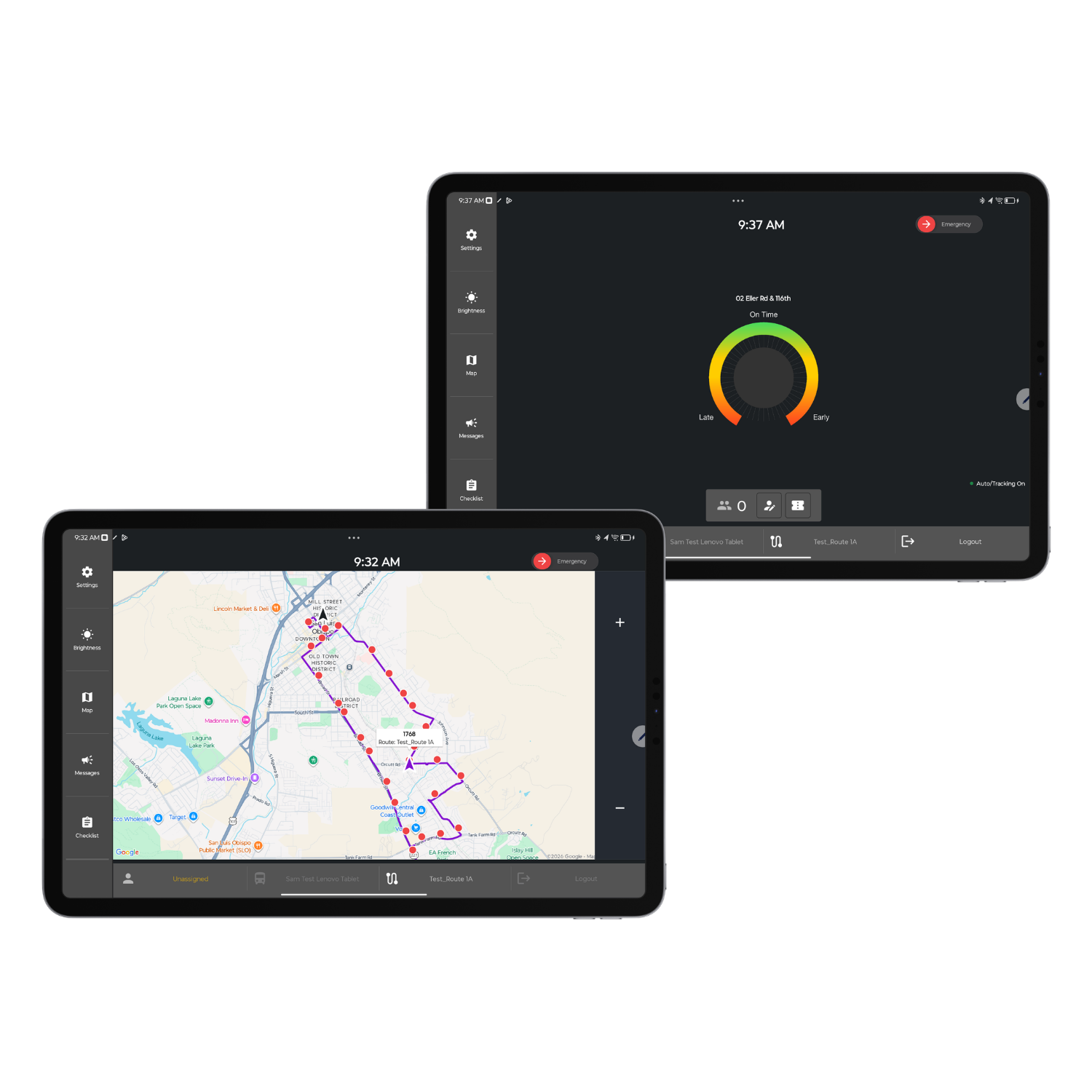
Mobile Data Terminals - In-Vehicle Operator Tools
Equip shuttle operators with rugged MDTs that keep them connected to dispatch and informed of schedule status without taking eyes off the road. Built for the frequent stops and tight campus navigation typical of hospital shuttle routes.
In-vehicle capabilities
- Turn-by-turn route guidance with stop-specific timing cues
- Early/late status at every timepoint on the route
- Two-way messaging with dispatch
- ADA announcement triggers integrated with AVAS
- Compatible with existing tablets or purpose-built transit MDT hardware

Branded Rider App - Live Shuttle Tracking for Patients, Visitors & Staff
Give riders the one thing they need most on an unfamiliar or stressful trip: a live map showing exactly where the shuttle is and when it's arriving. Branded with your health system's identity, not a generic transit logo.
Passenger experience features
- Live vehicle map with GPS-based arrival predictions
- Route selection across parking lots, satellite clinics, and campus buildings
- Push notifications for service alerts or schedule changes
- Branded UI matching the health system's visual identity
- Feeds directly from CAD/AVL - predictions reflect actual positions
Automatic Passenger Counting - Ridership Intelligence
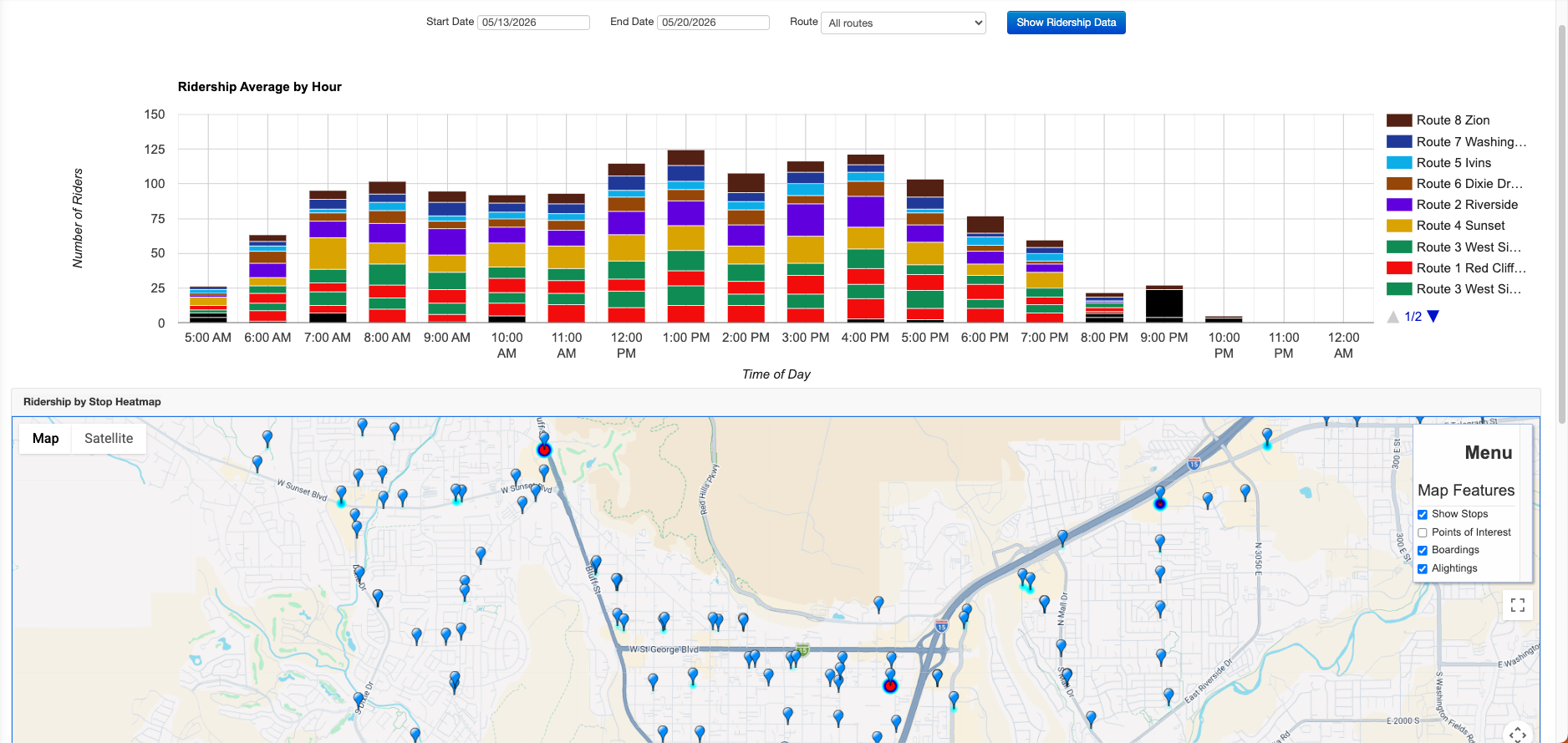
APC sensors capture boardings and alightings at every door on every stop, building a precise ridership dataset across all campus routes. Understand demand by route, time of day, and shift pattern without manual counting or sampling.
Data your planning team will use
- Load factor analysis by route, run, and time period
- Identify peak demand windows tied to shift changes and visiting hours
- Support vehicle assignment and accessible-seating capacity planning
- NTD ridership reporting for FTA-funded service
- Integrates with CAD/AVL data for combined performance analysis
Automatic Voice Announcements - ADA-Compliant Stop Calls
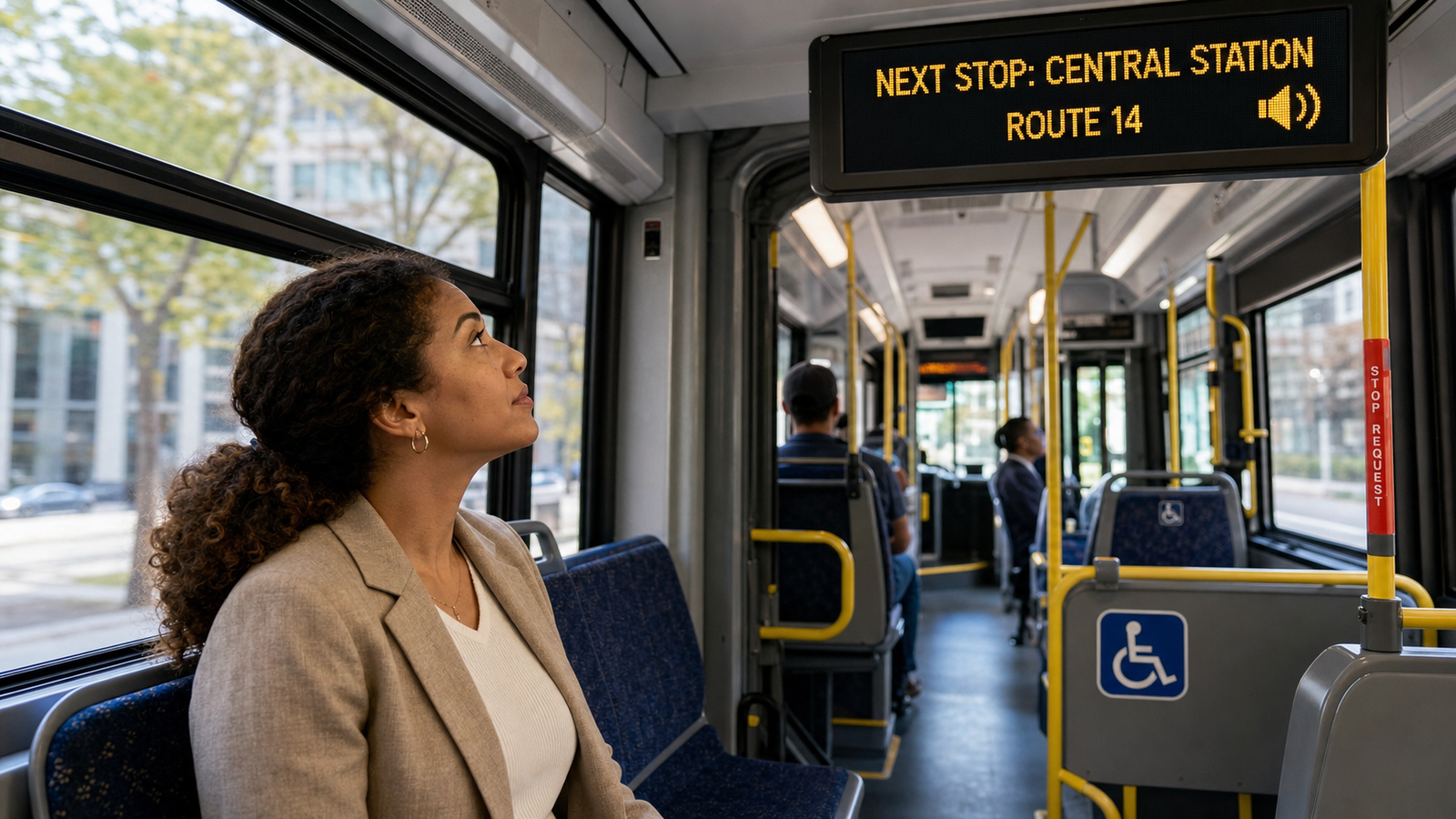
GPS-triggered automated announcements deliver consistent stop identification and route information on every run, every day - regardless of operator. Built to meet ADA Section 37.167 requirements for fixed route transit, helping ensure every rider can navigate the campus confidently.
Why it matters for healthcare campuses
- Audible stop announcements for patients and visitors with visual impairments
- Consistent service quality independent of individual operators
- Configurable volume levels suited to a calm, patient-centered environment
- Supports multi-language announcements for diverse patient and visitor populations
Digital Signage - Real-Time Passenger Information Displays
Put live shuttle arrival times and route information exactly where riders look: in main lobbies, parking structure entrances, satellite clinic waiting areas, and employee break rooms. Content is driven by live CAD/AVL data, not static schedules.
Display capabilities
- Live next-arrival countdowns based on real vehicle GPS positions
- Multi-route displays for facilities serving several campus connectors
- Health system-branded layouts with your color scheme and typography
- Compatible with commercial displays, kiosks, and existing signage hardware

Hospital Shuttle Service Types
Tailored to Every Type of Healthcare Campus Route
Peak Transit manages the full range of fixed route services that hospital and healthcare campus transportation programs operate - each with its own scheduling demands, rider population, and accessibility requirements.

Parking-to-Entrance Shuttles
High-frequency shuttles connecting remote parking lots to hospital entrances carry patients managing mobility limitations alongside visitors and staff. Peak Transit keeps every loop on schedule and every lobby display updated with live arrivals, so no one is left guessing in a parking lot.
High Frequency
Accessible Vehicles
APC Integration
Multi-Campus & Satellite Clinic Connectors
Health systems spanning multiple buildings, campuses, or satellite clinics need reliable inter-facility transportation for patients, staff, and equipment transfers. Real-time tracking and rider app predictions help riders plan connections between facilities with confidence.
Inter-Facility Routes
Scheduled Headways
Rider App

Employee Park-and-Ride & Shift Transportation
Clinical and support staff run on shift schedules with little tolerance for late shuttles before a handoff. Fixed route timetables, MDT schedule feedback, and dispatch-to-operator messaging help ensure your workforce gets to their units and parking on time.
Shift-Change Schedules
MDT Dispatch
Performance Reports
Why Peak Transit
Six Reasons Hospitals Choose Peak Transit
Integrated by design. Built for the operational realities of healthcare campus transportation.
One Platform, Six Capabilities
CAD/AVL, MDTs, rider app, APC, AVAS, and digital signage share a single back-end. No integration middleware, no separate vendor contracts, no data silos between systems.
Scheduled Service Intelligence, Native
Schedule adherence, timepoint monitoring, headway tracking, and NTD reporting are core features - not bolt-ons. Peak Transit understands fixed route service the way healthcare transportation teams think about it.
Zero-Disruption Installation
Hardware installations are scheduled overnight or during low-traffic windows. Phased rollouts by route keep live shuttle service uninterrupted throughout the deployment period - important on a campus that never closes.
ADA & FTA Compliance Built In
AVAS meets ADA Section 37.167 stop announcement requirements. APC and CAD/AVL data feeds NTD reporting for FTA Sections 5307, 5311, and 5339 funded operations. Compliance isn't a configuration - it's default behavior.
SOC 2 Type II Security
Enterprise-grade security with role-based access controls, encrypted data transmission, and regular audits. Satisfies hospital IT and security review requirements without custom negotiation.
Dedicated Implementation Support
A dedicated account manager guides every deployment from system configuration through full rollout. 24/7 critical issue support, quarterly business reviews, and ongoing training included - not priced separately.
Technical Specifications
Enterprise-Grade Technology for Healthcare Campus Transportation
Cloud-native architecture that scales from a single-campus shuttle loop to a multi-facility health system network - with the security posture hospital IT departments require.
99%
Cloud uptime guarantee
- Automatic updates, no interruption
- Scalable to handle growth from 5 to 500+ vehicles
- Redundant systems for continuous operations
3s
Real-time performance
- GPS updates every 3-5 sec when using PT hardware
- Sub-second dispatch console refresh rates
- Instant alert notifications
- Live data feeds to signage and rider app
SOC2
Security &Compliance
- SOC 2 Type II certified
- Role-based access controls
- Encrypted data transmission
- Regular security audits
GTFS
Open Data Standards
- GTFS & GTFS-RT data outputs
- NTD-formatted ridership reports
- iOS and Android operator apps
Implementation
Fast Deployment Without Service Disruption
A proven deployment methodology designed around the operational constraints of live hospital shuttle service - phased by route, scheduled around service hours on a campus that runs around the clock.
Use Your Existing Hardware
Average 4 Weeks
Week 1: System configuration, route data import, and campus setup
Week 2: Dispatcher and administrator training on the console and reporting tools
Week 3: Operator training on MDTs and pilot launch on first route
Week 4: Full fleet rollout across all campus and inter-facility routes
VS
INSTALL NEW Hardware
Average 8 Weeks
Week 1-2: System configuration and route data import
Week 3-4: Dispatcher and administrator training
Week 5-6: Operator training and pilot circuit launch
Week 7-8: Full fleet rollout across all routes
Ongoing support included
Dedicated account manager, 24/7 technical support for critical issues, regular system health checks, quarterly business reviews, and continuous training for new dispatchers and operators. Hardware installations are scheduled overnight or during low-activity windows - zero disruption to live shuttle service on your campus.
Comparison
What You Get With Peak Transit
Every feature in Peak Transit's platform was designed for the realities of scheduled fixed route transit - the scheduling logic, compliance requirements, and rider communication needs that define healthcare campus transportation.
Peak Transit - Purpose-Built for Fixed Route Transit
- Six integrated tools on one platform - CAD/AVL, MDT, rider app, APC, AVAS, and digital signage with shared data, no middleware.
- Fixed route schedule adherence with timepoint-based monitoring, early/late detection, and headway tracking built natively.
- ADA-compliant AVAS meeting Section 37.167 stop announcement requirements out of the box.
- NTD-compliant reporting for FTA-funded healthcare transit - service hours, miles, ridership, and on-time performance formatted for submission.
- GTFS/GTFS-RT data feeds for integration with hospital wayfinding systems and campus apps.
- Zero-disruption hardware installation scheduled around live service windows - no forced downtime on a campus that never closes.
Generic Fleet Tracking - Built for Delivery Logistics
- Disconnected point solutions for tracking, apps, and signage requiring separate vendor contracts and custom integrations.
- No schedule awareness - GPS dot on a map with no understanding of routes, stops, or timetables.
- No ADA stop announcement capability - third-party hardware required at additional cost.
- Generic odometer and mileage reports - NTD-format outputs require manual reformatting in spreadsheets.
- No standard GTFS output - hospital IT teams must build custom integrations or pay for middleware.
- Installation scheduled on vendor timeline with no accommodation for live transit service constraints.
FAQ
Common Questions About Hospital Shuttle Transit Software
Answers to the questions hospital transportation directors and operations managers ask most often when evaluating Peak Transit.
What fixed route transit software does Peak Transit offer for hospitals?
Peak Transit offers a fully integrated suite of fixed route transit tools purpose-built for hospital and healthcare campus shuttle operations. The platform includes CAD/AVL for real-time fleet tracking and dispatch, Mobile Data Terminals (MDTs) for in-vehicle operator communication, a custom-branded rider app with live arrival predictions, Automatic Passenger Counting (APC) for ridership data, an Automatic Voice Announcement System (AVAS) for ADA-compliant stop announcements, and digital signage for real-time passenger information displays in lobbies and at major stops. All components share a unified back-end, eliminating the need to manage multiple vendor relationships.
How does CAD/AVL software improve hospital shuttle operations?
CAD/AVL software gives hospital transportation managers complete real-time visibility into every shuttle across every campus and route - parking-to-entrance loops, inter-facility connectors, and employee transportation. Dispatchers can monitor schedule adherence, communicate directly with operators via two-way messaging on MDTs, deploy service adjustments during shift-change surges or weather delays, and receive automatic alerts for route deviations. Historical performance analytics identify chronic delay locations so operations teams can optimize schedules and reduce rider wait times. For systems with FTA Section 5307 or 5311 funding, the platform generates NTD-compliant service reports automatically.
Can patients and visitors track hospital shuttles in real time on their phones?
Yes. Peak Transit's branded rider app gives patients, visitors, and staff live shuttle tracking, real-time arrival predictions, and route information - all branded with the health system's identity. The app connects directly to the CAD/AVL system, so predictions are based on actual vehicle GPS positions rather than static schedules. Riders can see exactly where the shuttle is and how many minutes until arrival, which matters most for visitors and patients navigating an unfamiliar campus.
Does Peak Transit's AVAS system meet ADA requirements for hospital shuttles?
Yes. Peak Transit's Automatic Voice Announcement System (AVAS) is designed to meet ADA Section 37.167 requirements for fixed route transit, which applies to hospital shuttle services operating as fixed route systems. The system delivers automated stop and route announcements triggered by GPS location, ensuring consistent compliance regardless of operator. Announcements cover stop identification, building names, and service information. Audio output is configurable for calm, patient-centered cabin volume levels, and the system supports multi-language announcements for diverse patient and visitor populations.
What ridership data can automatic passenger counters provide for hospital shuttles?
Peak Transit's APC system captures boardings and alightings at every stop on every run, building a precise ridership dataset for each campus route. Operations managers can analyze load factors by time of day, shift pattern, and visiting hours - critical for healthcare environments where demand spikes around shift changes and peak visiting periods. The data supports capacity planning decisions such as deploying accessible vehicles where needed most, adjusting headways for overnight shifts, and documenting service delivery for FTA grant reporting and NTD submissions.
How long does implementation take for a hospital shuttle operation?
Most hospital shuttle operations are fully operational on Peak Transit's platform within 4–8 weeks, depending on fleet size and whether new hardware is being installed. Implementation follows a structured phased approach: system configuration and route data setup in weeks one and two, dispatcher and administrator training in week three, operator training and pilot route launch in week four, and full fleet rollout through week five or beyond. Peak Transit schedules all hardware installation during overnight windows or low-traffic periods to ensure zero disruption to live shuttle service on a campus that operates around the clock.
What types of hospital shuttle routes does Peak Transit support?
Peak Transit supports all fixed route service patterns common to healthcare campuses: high-frequency parking-to-entrance shuttles, multi-campus and satellite clinic connector routes, and employee park-and-ride or shift transportation on defined schedules. The system also handles mixed-use fleets where the same vehicles serve different routes at different times of day, with route and schedule management handled centrally through the dispatch console.
Does Peak Transit integrate with hospital campus systems?
Peak Transit's platform outputs GTFS and GTFS-RT feeds, making real-time vehicle position and schedule data available to any downstream system that consumes standard transit data formats. This includes hospital wayfinding systems, campus mobile apps, and third-party passenger information displays.
Get Started
Ready to Modernize Your Hospital's Shuttle Operations?
See how Peak Transit's integrated fixed route transit platform can improve schedule adherence, support patient and visitor mobility, and simplify operations across every route on your campus.