
Capture boarding and alighting data on every fixed route, on every vehicle, on every trip - without operator input. Peak Transit's APC system delivers NTD-grade ridership data, feeds it directly into your CAD/AVL reporting, and gives planners the evidence they need to defend service decisions, justify funding, and right-size routes.
Automatic Passenger Counting (APC) for
Fixed Route Transit

Trusted by transit agencies nationwide
Ridership data your agency can actually defend
For most fixed route transit agencies, ridership numbers carry real budget weight. They drive NTD reporting, FTA Section 5307 formula funding, service planning decisions, council and board presentations, and the case for every route adjustment. Manual driver counts and sample-based surveys can't keep up - they miss trips, drift in accuracy, and leave gaps when you need the numbers most.
Peak Transit's Automatic Passenger Counting (APC) system captures boarding and alighting data on every door, every stop, every trip - automatically. The data lands in the same Peak Transit platform running your CAD/AVL, MDTs, and rider apps, so ridership becomes a connected operational metric, not a separate reporting project.
The Peak Transit difference
Built specifically for fixed route operations. APC data is tied to your scheduled stops, timepoints, blocks, and runs - so you don't just know how many people rode the bus, you know which trip, which stop, which time of day, and which route drove the number. That's the level of detail planners need to make real decisions.
Core Capabilities
What automatic passenger counting does for your agency
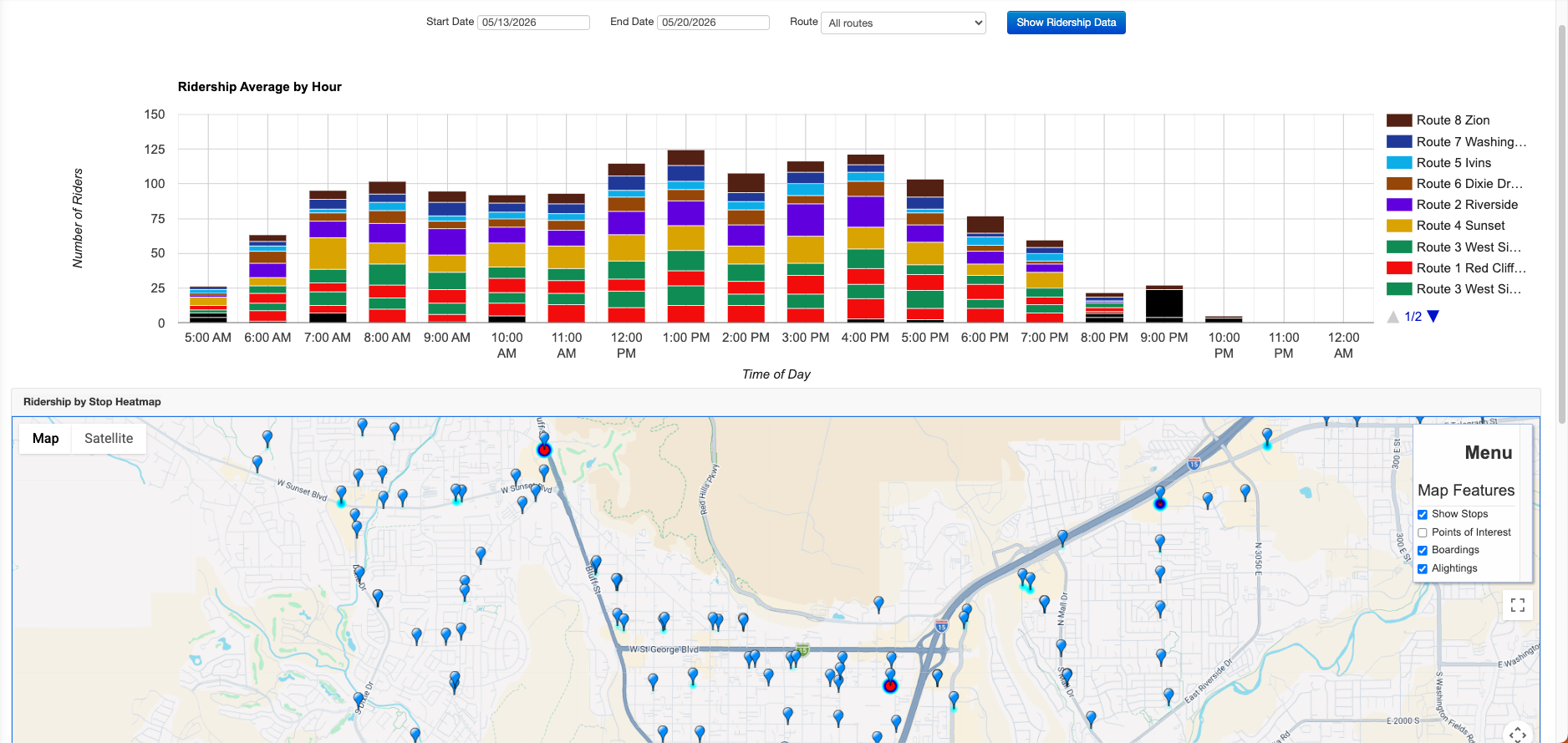
Captures NTD-grade ridership data without driver input
NTD reporting requires accurate, statistically defensible ridership data. APC removes operator counting from the equation entirely - door-mounted sensors record every boarding and alighting automatically, on every trip, with the consistency NTD and FTA reviewers expect.
Benefits for your operations
- Continuous ridership capture across the full fleet
- Removes operator workload and inconsistency
- Statistically defensible numbers for NTD reporting
- Supports FTA Section 5307 formula funding calculations
- Built-in audit trail for compliance reviews
Strengthens funding requests and budget defense
When you go to council, the board, or your funding authority asking for more service hours, expanded routes, or replacement vehicles, ridership data is the case. APC gives you trip-level numbers that hold up under scrutiny - not estimates, not samples, not driver memory.
Benefits for your operations
- Route-level ridership data ready for budget cycles
- Trip-level detail to justify service additions or cuts
- Trend data across months, quarters, and years
- Defensible numbers for grant applications
- Stronger position in federal and state funding conversations


Right-sizes service to actual demand
Without APC, agencies tend to either over-serve or under-serve. With it, you can see exactly which trips run empty and which trips run crowded - by route, time of day, day of week, and stop. That's the foundation of evidence-based service planning.
Benefits for your operations
- Identifies underperforming trips for adjustment
- Identifies crowded trips needing capacity
- Supports headway and frequency decisions
- Informs route consolidation or expansion
- Reduces wasted service hours on low-demand trips
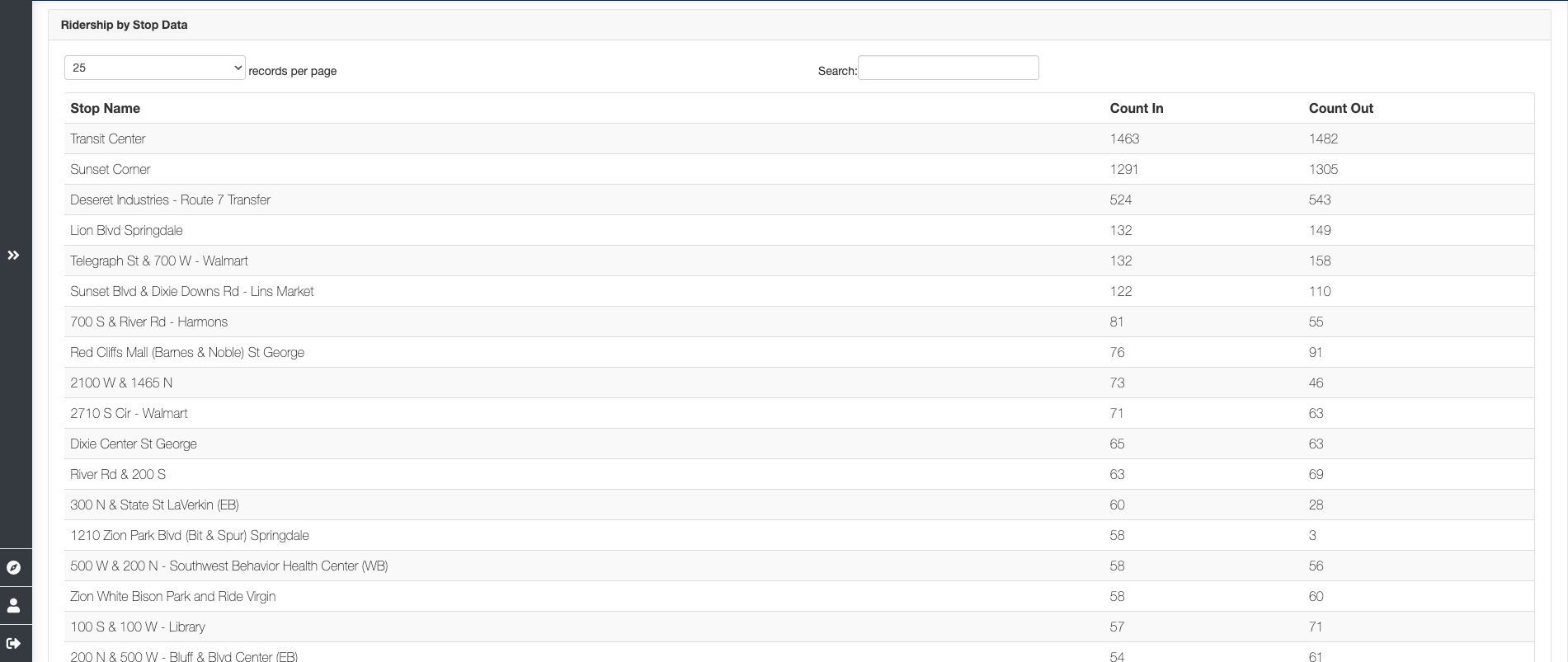
Provides stop-level boarding and alighting detail
APC captures data at the door, which means you see exactly where people get on and off. Stop-level data exposes which stops drive ridership, which stops are unused, and where ridership concentrates - all critical inputs for stop consolidation, shelter investment, and ADA improvements.
Benefits for your operations
- Boardings and alightings recorded per stop
- Origin/destination patterns by stop pair
- Data to support stop consolidation decisions
- Evidence for shelter and amenity investment
- Supports ADA stop-level planning

Replaces manual ride checks and sampling
Manual ride checks are expensive, infrequent, and labor-intensive. Most agencies can only afford to sample a fraction of trips per year. APC runs continuously across the entire fleet, eliminating the need for most ride-check labor while delivering far more data than any sampling program could produce.
Benefits for your operations
- Replaces most manual ride-check labor
- 100% trip coverage instead of statistical sampling
- Frees planning staff for analysis instead of data collection
- Eliminates seasonal ride-check budget spikes
- Continuous data instead of point-in-time snapshots
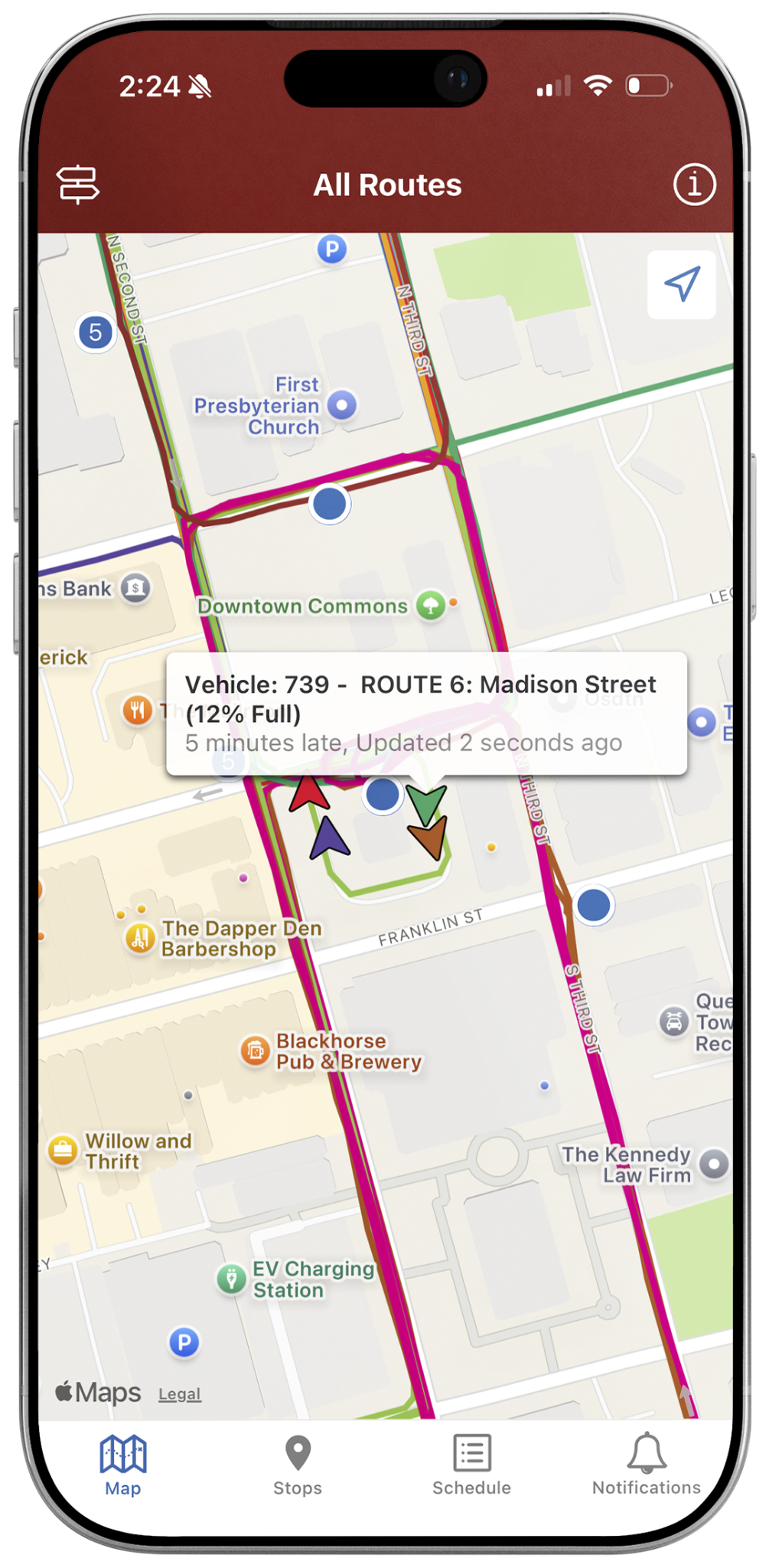
Powers vehicle capacity features for riders
When connected to Peak Transit's branded rider app and digital signage, APC data can show riders approximate vehicle capacity in real time - useful for university shuttles, airport circulators, and any route where crowding is a regular rider concern. Lower-crowding perception, higher rider satisfaction.
Benefits for your operations
- Real-time capacity indicators in the rider app
- Capacity information on digital signage
- Reduces overcrowding complaints
- Encourages better rider distribution across trips
- Tied directly to your existing Peak Transit ecosystem
Industries we serve
APC configurations tailored to your fixed route environment

City and county transit agencies use APC to meet NTD reporting requirements, defend FTA formula funding, and make evidence-based decisions on service hours, route restructuring, and frequency. APC turns ridership data from a reporting chore into an operational asset.
City buses
regional authorities
county services
Multi-jurisdictional transit

Campus transportation departments use APC to manage class-time demand surges, justify shuttle service expansion to administration, and balance routes across academic schedules. Trip-level data supports the conversations with student affairs, parking, and facilities about who's actually riding.
Intercampus connectors
Parking shuttles
Campus circulators
Student housing shuttles

Airport authorities and ground transportation operators use APC to size rental car center shuttle frequency, allocate parking lot circulator capacity, and prove ridership numbers to airport operations leadership. Data supports decisions about adding vehicles during peak travel periods and pulling them during slow ones.
Rental car shuttles
Airport ground transport
Employee transport

Health systems use APC to manage multi-campus shuttle demand, support shift-change scheduling, and demonstrate utilization to health system leadership. Patient and visitor transportation often competes for budget - APC data provides the evidence to defend it.
Multi-campus shuttles
Patient Transport
Shift-change Routes
Medical center parking
NTD-grade accuracy
Statistically defensible ridership numbers that hold up under NTD and FTA review - without driver counting workload.
Connected to your CAD/AVL
APC data is tied to routes, trips, stops, blocks, and runs in the same Peak Transit platform - not a separate system to maintain.
Hardware flexibility
Works with Peak Transit's IRIS-developed sensors and integrates with most major third-party APC equipment your agency already owns.
Stop-level granularity
See boardings and alightings at every stop, on every trip - the detail planners need for real decisions.
Budget and funding defense
Ridership data ready for council, board, NTD, FTA, and grant submissions. Defensible numbers for every funding conversation.
Eliminates ride-check labor
Replace expensive sample-based ride checks with continuous, full-fleet coverage - and redirect planning staff to analysis.
Technical Specifications
Enterprise-grade technology for fixed route ridership data
Peak Transit's APC platform meets the technical and procurement standards transit agencies operate under, with the integration depth fixed route operations require.
95%
Counting accuracy
- 95%+ counting accuracy on validated installations
- APTA-aligned accuracy methodology
- Calibration support and ongoing accuracy monitoring
- Hardware diagnostics surfaced in dispatch console
SOC2
Security &Compliance
- SOC 2 Type II certified platform
- Encrypted data transmission from vehicle to cloud
- Role-based access for planners, operations, and admins
- Audit trail for every ridership data point
- Regular security audits and updates
GTFS / NTD
Standards-based reporting
- GTFS and GTFS-Realtime feed support
- NTD-formatted ridership exports built in
- Unlinked passenger trips and passenger miles calculations
- Custom reporting for state DOT and grant requirements
24/7
Connected platform
- Native integration with Peak Transit CAD/AVL
- Direct connection to Peak Transit Mobile Data Terminals
- Feeds branded rider app and digital signage
- Hardware-flexible - works with IRIS and major third-party APCs
Implementation
Fast Deployment, Comprehensive Support
Most agencies are capturing reliable APC data within weeks of installation start - and producing NTD-ready reports within their first full reporting period.
Average 6 Weeks
Week 1-3: Install & calibrate
APC hardware installation, sensor calibration, and integration with your existing Peak Transit CAD/AVL and MDT environment. Phased by garage or vehicle group if preferred.
Week 4-6: Validate & train
Accuracy validation against control counts, NTD reporting setup, and training for your planning, operations, and reporting staff on the dashboards and exports they'll use.
Ongoing support included
Dedicated account manager, 24/7 technical support for critical issues, regular sensor health monitoring, ongoing calibration support, and continuous improvements to reporting capabilities at no additional cost.
Comparison
Why agencies choose Peak Transit APC
Fixed route agencies have three real options for ridership data. Here's how Peak Transit APC compares.
Peak Transit APC
✓ Purpose-built for fixed route transit - data tied to routes, trips, stops, blocks, and runs.
✓ NTD-ready reporting built in - unlinked passenger trips and passenger miles calculations included.
✓ Hardware flexible - works with our IRIS-developed sensors and most third-party APC equipment.
✓ Fully integrated with CAD/AVL and MDTs - one platform, one source of truth.
✓ Stop-level granularity - boardings and alightings at every stop, every trip.
✓ Continuous full-fleet coverage - every revenue trip, automatically.
✓ Powers rider-facing capacity features - through the branded rider app and digital signage.
Manual Driver Counts and Ride Checks
✗ Operator-dependent accuracy - counts vary by driver, fatigue, and workload.
✗ Sample-based coverage - most agencies can only afford to check a fraction of trips per year.
✗ Labor-intensive - ride-check staffing competes with planning budget.
✗ Point-in-time snapshots - no longitudinal data between sampling periods.
✗
Hard to defend at NTD review - statistical methodology under increasing scrutiny.
Generic Third-Party APC Without Integration
✗ Separate platform - APC data lives in its own silo away from CAD/AVL.
✗ Manual integration work required - to tie counts to routes, trips, and stops.
✗ Limited reporting - generic counts without transit-specific context.
✗ No connection to rider-facing systems - capacity features require additional integration.
✗
Procurement and support across multiple vendors - more contracts, more risk.
FAQ
Common questions about Automatic Passenger Counting for fixed route transit
What is Automatic Passenger Counting (APC) in fixed route transit?
Automatic Passenger Counting is a system of door-mounted sensors that automatically record boardings and alightings on transit vehicles without operator input. In fixed route service, APC data is tied to scheduled routes, trips, stops, and timepoints - giving agencies trip-level and stop-level ridership detail across the full fleet, continuously, instead of relying on driver counts or sampled ride checks.
How accurate is Peak Transit's APC system?
Validated installations consistently achieve 95%+ counting accuracy, in line with APTA accuracy methodology. Accuracy is monitored continuously, with calibration support included in the platform. Hardware diagnostics surface in the dispatch console so accuracy issues are caught and addressed quickly.
Will APC data meet our NTD reporting requirements?
Yes. Peak Transit's APC reporting includes NTD-formatted exports with unlinked passenger trips, passenger miles, and the statistical context NTD reviewers expect. Agencies use Peak Transit APC data as the primary input for their annual NTD submissions.
Can we integrate APC with our existing CAD/AVL system?
Peak Transit APC is built into the same platform running our CAD/AVL, MDTs, branded rider app, and digital signage. If your agency uses a different CAD/AVL system, talk to us about feed-based integration - the APC system can deliver data into external platforms via standard formats.
We already have third-party APC hardware on part of our fleet. Can you work with it?
Yes. Peak Transit's APC platform is hardware-flexible and integrates with most major third-party APC equipment. Agencies can phase deployment - bringing existing equipment into the same reporting platform while expanding coverage with Peak Transit's IRIS-developed sensors over time.
How does APC compare to manual driver counts?
Manual counts depend on operator attention and consistency, are typically captured only on sample trips, and require post-trip data entry. APC captures every boarding and alighting on every revenue trip automatically, with statistically defensible accuracy. Most agencies see immediate reductions in ride-check labor and dramatic increases in data coverage after deploying APC.
Will APC eliminate the need for ride checks entirely?
For most fixed route agencies, APC replaces the bulk of routine ride-check labor. Some agencies retain a small ride-check program for accuracy validation, specialized data collection, or rider experience research - but the data-collection burden is dramatically reduced.
What kind of reports does the system produce?
Reports include trip-level ridership, stop-level boardings and alightings, load factor by trip and time of day, peak load points, headway-based ridership, longitudinal trend analysis, and NTD-formatted exports. Reports can be scheduled for automatic delivery to planners, operations, and reporting staff.
Can APC support our funding and grant applications?
Yes. APC data is one of the strongest inputs for FTA Section 5307 formula funding, federal and state grant applications, and council or board budget defense. The data is statistically defensible, audit-ready, and broken down to the level of detail funding authorities expect.
How does APC support service planning?
Trip-level and stop-level ridership data is the foundation of evidence-based service planning. Planners use APC data to identify underperforming trips, justify expansion of crowded ones, evaluate headway and frequency, restructure routes, consolidate stops, and prove the impact of service changes after the fact.
Does APC work with the Peak Transit branded rider app?
Yes. APC data can feed vehicle capacity indicators into the branded rider app and digital signage, letting riders see approximate crowding on incoming vehicles. This is optional - agencies choose whether to enable rider-facing capacity features.
How long does APC deployment take?
Most agencies are capturing reliable data within 3–6 weeks of installation start, with NTD-ready reporting available within the first full reporting period. Deployment can be phased by garage, vehicle group, or route as needed.
What does APC integration with MDTs do?
Peak Transit APC is integrated with our Mobile Data Terminals so ridership data is tied to the same vehicle, operator, route, block, and run context running on the driver's display. The MDT also supports manual passenger counting as a backup for any vehicle or trip where automatic counts are unavailable.
Can the system distinguish between passenger types?
APC sensors count individuals; they do not identify passengers personally. For agencies that need fare-based ridership distinctions (full fare, reduced fare, pass holders), APC data is typically reconciled with fare collection data in reporting - Peak Transit can support that workflow.
Is APC data secure?
Yes. Peak Transit operates on a SOC 2 Type II certified platform with encrypted data transmission, role-based access controls, full audit trails, and regular security reviews. APC sensors count only - they do not capture personally identifiable information about riders.
Get Started
Ready to put real ridership data behind every service decision?
See how Peak Transit's Automatic Passenger Counting system gives your agency NTD-grade ridership data, full-fleet coverage, and the planning and funding evidence to defend every route decision - integrated with the CAD/AVL and MDT platform already powering your fixed route operations.